
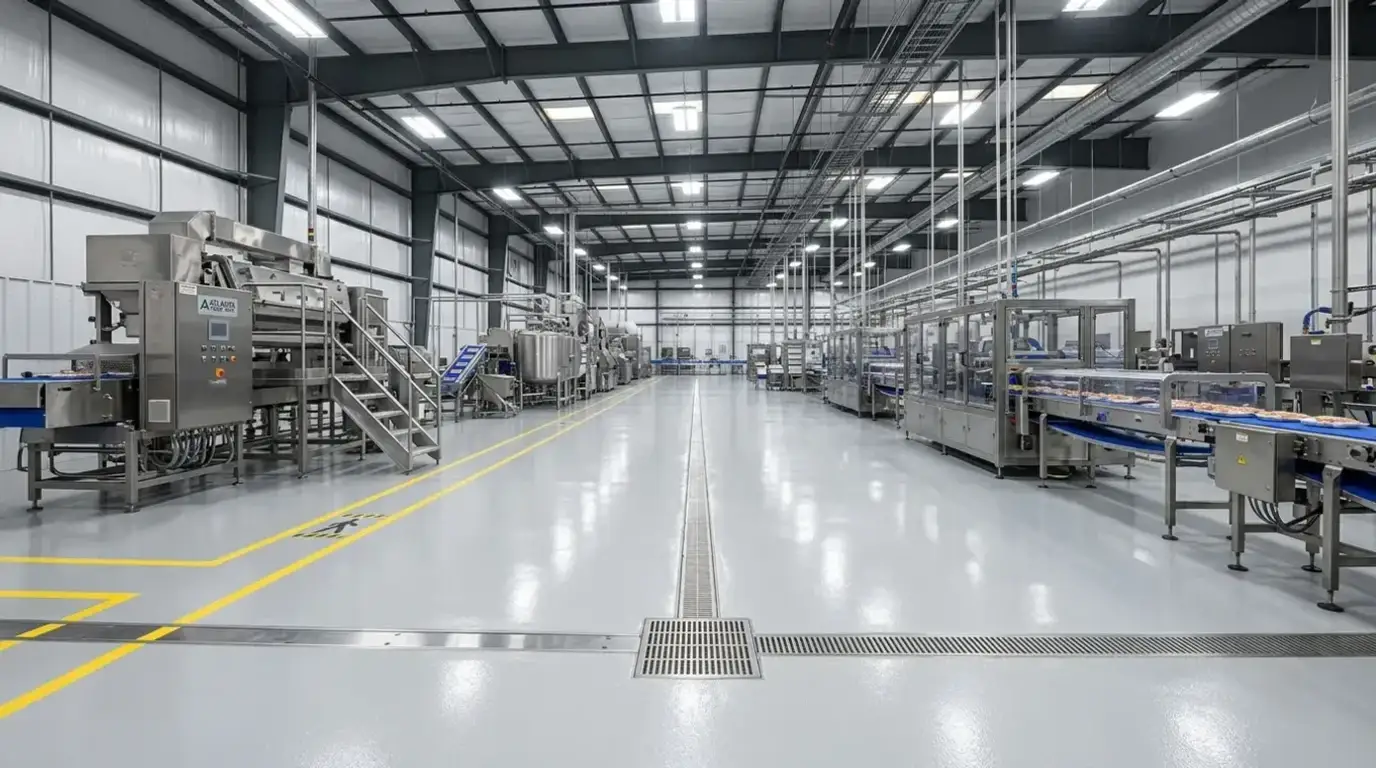
Food and beverage production floors face a combination of heat, moisture, and chemical exposure that most commercial flooring systems were never built to handle. For Atlanta food processors, commercial kitchens, breweries, and beverage plants, urethane cement has become a go-to system when hot-water washdowns, steam cleaning, and heavy sanitation schedules push a standard coating past its limits. Concrete Masters works with commercial and industrial facilities across Atlanta and the surrounding Fulton, DeKalb, Cobb, Gwinnett, and Fayette County area, specifying flooring systems based on how a facility actually operates, not just how a floor looks.
The Operating Conditions That Point to Urethane Cement
Urethane cement is a thermal-shock-rated system built for areas exposed to hot-water washdowns and steam cleaning, and it can bond to damp concrete, which matters in production environments where a bone-dry slab is rarely realistic. According to Master Builders Solutions, polyurethane-cement systems are engineered specifically for severe temperature changes, which is why this material becomes most relevant where thermal cycling is part of daily operations rather than an occasional event. The right call depends on the facility's actual exposures, not a blanket assumption that one system fits every production floor.
Why Food and Beverage Floors Face Unique Demands
Production and wash areas create a mix of stresses that a general-purpose floor coating isn't designed to absorb. Concrete Masters points to several recurring challenges in food and beverage environments:
- Organic acids from food processing and fermentation
- Caustic cleaning agents and sanitizing chemicals used daily
- Hot-water washdowns hitting a cold concrete slab
- Microbial growth in porous concrete and at joint lines
- Wet slip hazards created by fats, oils, and standing water
Each of these factors adds up over time, which is why the flooring decision for a production or wash-down area needs to account for more than appearance or short-term cost.
What Georgia and Federal Food-Service Rules Require
Flooring decisions in food and beverage facilities aren't purely a performance question. The FDA Food Code requires food-service floor surfaces to be smooth, durable, and easily cleanable, with nonabsorbent surfaces in moisture-prone areas, antislip treatments where safety requires it, and coved, sealed floor-to-wall junctures in wet or flush-cleaned zones. Georgia adds its own layer on top of that: the Georgia Department of Public Health requires floors subject to water-flush cleaning to be graded to drains, equipped with floor drains, and finished with coved, sealed transitions at the walls. Poured resin flooring at a minimum of 1/8 inch is treated as equivalent to standard tile for finish-schedule purposes, which is a useful benchmark when a wash-down area is being specified.
Evaluating the Slab Before You Specify a System
A finish floor shouldn't be chosen from appearance alone. Moisture vapor transmission that exceeds a flooring system's tolerance can contribute to blistering, delamination, adhesive failure, efflorescence, mold, and odor, so slab condition has to be part of the conversation before urethane cement or any other system gets specified. Concrete Masters maps a facility's chemical exposure profile and matches the resin system to the specific agents in use, and factors in details like integrated cove bases, floors sloped to drains with trench-drain integration, phased installations, and fast-cure systems so production downtime stays manageable.
Where an existing slab has moisture or flatness issues, concrete vapor remediation and self-leveling concrete are evaluated first, since Concrete Masters tests moisture levels before recommending a system and verifies results after mitigation, and assesses slab condition, flatness, and moisture before any finish flooring goes down. In practice, the decision comes down to an exposure profile that includes:
- Washdown temperature and how often thermal cycling occurs
- The specific cleaning and sanitizing chemicals in use
- Wet traction needs in production and walkway areas
- Drain configuration and slope requirements
- Traffic patterns and impact exposure
- Substrate moisture conditions
- How quickly the area needs to return to service
Weighing these factors against a facility's day-to-day operation is what determines whether urethane cement is the right fit, or whether another system in the lineup, like quartz broadcast epoxy, antimicrobial flooring, or novolac epoxy, better matches the exposure.
Specifying the Right Floor for Your Atlanta Facility
Concrete Masters works with food processing plants, commercial kitchens, breweries, and beverage facilities across Atlanta and the surrounding Fulton, DeKalb, Cobb, Gwinnett, and Fayette County area, starting every project with a look at the facility's actual washdown, chemical, and drainage conditions. If your production or sanitation area is dealing with hot-water washdowns, steam cleaning, heavy chemical exposure, or a slab that needs evaluation before a new floor goes in, our team can walk through the details with you. Call (404) 934-0424 to discuss your facility's flooring needs, or learn more about our food and beverage flooring services for Atlanta-area commercial and industrial operations.