
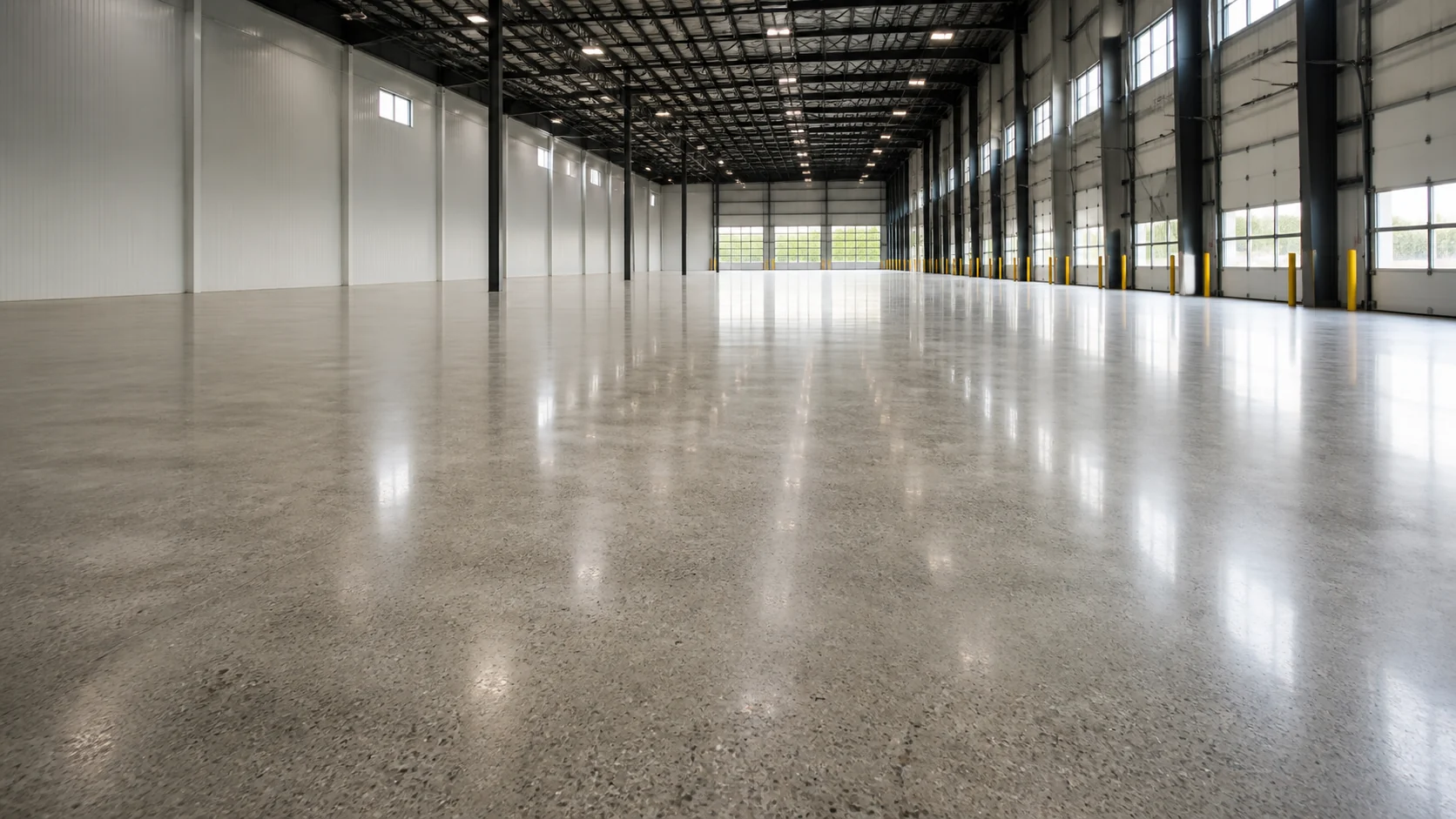
Choosing between epoxy and polished concrete for a warehouse floor is not really an either-or decision. The better question is which system fits each zone of your facility. Concrete Masters has installed more than 1,000,000 square feet of warehouse flooring across Metro Atlanta, working with the conditions that actually wear down a warehouse slab: forklift and pallet-jack traffic, racking point loads, hydraulic fluid, battery acid, diesel, cleaning agents, and round-the-clock operations.
The short answer: polished concrete is generally the better fit for dry, high-traffic field areas and main aisles with a suitable existing slab, since it becomes the finished floor and does not require waxing or recoating. Epoxy is generally the better fit where chemical exposure, impact protection, anti-slip texture, or color-coded safety zones are a requirement. Slab moisture and your installation schedule can also shape the final specification.
Match the Floor to the Zone, Not the Whole Building
Warehouses are not one uniform environment. A main traffic aisle, a battery-charging area, a loading dock, a pedestrian route, and a maintenance bay can each have different exposure and performance needs. Rather than picking a single system for the entire facility, it is usually more effective to evaluate flooring zone by zone.
- Dry storage and main traffic aisles: steady forklift and pallet-jack travel, few chemical spills
- Battery-charging and chemical-exposure areas: exposure to battery acid, hydraulic fluid, diesel, or cleaning agents
- Loading docks: higher impact and abrasion from staging and transitions
- Pedestrian routes: may benefit from visual safety demarcation
- Maintenance zones: often combine chemical exposure with impact loads
Where Polished Concrete Fits
Concrete Masters' polished concrete process uses progressive diamond tooling along with a liquid densifier that hardens the concrete from within, rather than adding a topical coating that can eventually peel. This approach is built around polished concrete for warehouse traffic aisles, and it is well suited to forklift and rolling-load traffic. Because polishing works with the existing slab instead of coating it, there is no waxing or stripping cycle to maintain, and the finish also improves light reflectivity across the floor. Concrete Masters uses Lavina and Kutrite diamond systems for this process.
Polished concrete tends to make the most sense for dry, high-traffic field areas where the existing slab is in suitable condition and chemical exposure is not the primary concern.
Where Epoxy Fits
Concrete Masters describes its epoxy as a multilayer, seamless, non-porous resinous system built for chemical, impact, and abrasion resistance, with 40 to 80 mil systems positioned specifically for these demands. Offered epoxy options include 100% solids, high-build, epoxy mortar, novolac, vapor-tolerant formulations, quartz broadcast finishes, and anti-slip aggregate, which supports commercial epoxy systems for chemical and impact exposure. Epoxy crews are manufacturer-certified for Key Resin and Westcoat systems.
Epoxy generally has the practical advantage in zones where chemical resistance, impact protection, anti-slip texture, or color-coded safety marking are actual requirements, such as battery-charging areas, chemical storage, or defined safety lanes.
Side-by-Side Comparison
| Factor | Polished Concrete | Epoxy |
|---|---|---|
| Best fit | Dry, high-traffic field areas and main aisles | Chemical exposure, impact zones, safety marking |
| Surface type | Densified existing slab, no topical coating | Multilayer seamless resinous coating |
| Maintenance | No waxing or stripping cycles | Varies by system and finish selected |
| Added options | Light reflectivity, rolling-load suitability | Quartz broadcast, anti-slip aggregate, color coding |
| Published starting price (Atlanta) | $1 to $8 per sq ft (large warehouses trend lower; higher gloss or full aggregate exposure adds cost) | $3 to $12 per sq ft (depends on system type, prep, and finish) |
These are Concrete Masters' published starting ranges, and actual pricing depends on the specific project.
Slab Moisture Can Change the Recommendation
Choosing epoxy before evaluating slab moisture can create a coating-failure risk. Concrete Masters uses ASTM F1869 and F2170 testing along with moisture-mitigation systems when needed. According to ASTM International, F2170 measures in-situ relative humidity in concrete, and test results serve as inputs to the selected manufacturer's system requirements rather than a universal pass or fail threshold. In practice, this means Atlanta humidity or soil conditions alone do not prove a slab has a moisture problem; the applicable limits depend on the coating or flooring system being specified.
When testing indicates mitigation is warranted, Concrete Masters offers Koster, Mapei, and Aquafin certified moisture mitigation for slab-on-grade warehouse floors, intended to prevent coating delamination before an epoxy system goes down.
Installation Timing and Operational Downtime
Active warehouses rarely have the luxury of shutting down for flooring work. Concrete Masters offers phased, zone-by-zone installation, including night and weekend shifts, so operations can continue in unaffected areas while work proceeds elsewhere. For facilities that need a zone back in forklift service within 24 hours, polyaspartic is offered as a fast-cure alternative to traditional epoxy. Scheduling constraints like these can factor into which system, or which zone-specific approach, makes the most sense for a given area.
Frequently Asked Questions
Can a warehouse use polished concrete in the main aisles and epoxy in battery-charging or maintenance areas?
Yes. Flooring decisions can be made zone by zone, so a facility can use polished concrete in dry, high-traffic field areas and epoxy in areas with chemical exposure, such as battery-charging or maintenance zones.
Should a warehouse slab be moisture tested before epoxy is specified?
Moisture testing using methods like ASTM F1869 and F2170 provides the data needed to confirm whether a slab meets the requirements of the specific epoxy system being considered, and mitigation can be applied when results call for it.
What warehouse conditions make anti-slip aggregate or color-coded safety zones worth considering?
Areas with pedestrian and forklift crossover, chemical handling, or defined safety lanes are where anti-slip aggregate and color-coded epoxy finishes tend to add the most practical value.
Get a Flooring Recommendation for Your Atlanta Warehouse
Concrete Masters serves warehouse and distribution facilities throughout Metro Atlanta, including Sandy Springs, Marietta, Duluth, Lawrenceville, Alpharetta, and surrounding Fulton, DeKalb, Cobb, Gwinnett, and Fayette County communities. If you are weighing epoxy against polished concrete for your warehouse, call (404) 934-0424 to talk through your facility's zones and requirements, or visit our warehouse and distribution flooring page to learn more.